

How To Draw A Pixel Character Traditionally
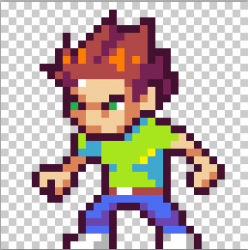
Acquire pixel art by making this cool game grapheme!
This is a guest postal service by Glauber Kotaki, an experienced second game artist available for hire.
Pixel Fine art is really pop in games these days, and for some swell reasons:
- Looks. Pixel art looks awesome! At that place's something to be said about making the nearly about each pixel in a sprite.
- Nostalgia. Pixel art brings back a great nostalgic feeling for gamers who grew up playing Nintendo, Super Nintendo, or Genesis (like myself!)
- Ease of learning. Pixel art is one of the easiest types of digital art to learn, especially if y'all are a more of a programmer blazon than an artist ;]
And then wanna try your hand at some pixel art? Follow forth with me and I'll bear witness you how to brand a simple but cool game character you can employ or tweak in your own games!
And equally a bonus, after I show you how to brand the character, Ray volition swoop in and show you how to integrate it into an iPhone game!
To follow along with this tutorial, you will need Adobe Photoshop. If yous exercise not have Photoshop, you can download a free trial from Adobe.
Read on to start pushing some pixels!
What Is Pixel Art?
Earlier we get started, let's exist really clear virtually what pixel fine art is – it's not as obvious as yous might retrieve. It'south also a affair of some debate and fashion, but bear with this definition for the sake of this tutorial :]
The easiest way to define pixel fine art is by maxim what is non pixel art: that is, annihilation that generates pixels
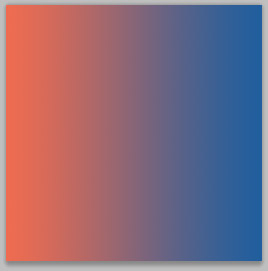
Gradient
Gradients: Choosing two colors and computing the ones between them in a infinite interval. Looks cool but not pixel art!

Mistiness
Mistiness tools: Identifying the pixels and replicating/editing them to make a new version of the previous paradigm. Once again not pixel art.

Anti-allonym
Anti-alias tool (basically, generating new pixels in different colors to something expect 'smoother'). You should avoid them for now.
Some would say that even automatically generated colors are not pixel art too, implying that layer blending effects (mixing pixels betwixt two layers in a preset algorithm) are not allowed. But since near hardware nowadays can deal with millions of colors, this can ignored – still, using fewer colors is a good practice of pixel art.
Other tools such every bit the line tool or the paint bucket tool also automatically generates pixels, but since you can configure them to not anti-alias their edges, giving you control over every pixel they fill, are considered 'pixel fine art friendly'.
So in the end, pixel art is all about taking bully care virtually the placement of each pixel in a sprite, nigh often manually and with a limited palette of colors. Let's try information technology out!
Getting Started
Earlier you lot start making your commencement pixel art asset, you should exist aware that pixel fine art is not easily resizable. If y'all try to scale it down, information technology will look like a mess. If you try to scale information technology up, it tin look OK every bit long as you use a multiple of 2 (but of course will be more pixelated).
To avoid this problem, you should first put some thought into exactly how large you want your game grapheme/enemy/game element to be before you get started. This should be based on the screen size of the device you lot're targeting, and how large y'all desire the "pixels" to look.
For example, allow'southward say you lot want the game to look double-sized on an iPhone 3GS ("I really want to give a retro, pixel look to my game!"), which resolution is 480×320 pixels. So your working resolution will be half of that size, or 240×160 pixels.
Open up a new sail on Photoshop (File > New…) and set this same size so you can wait at it and choose the size for your graphic symbol.

There: 32x32 pixels!
I chose 32×32 pixels not just considering it seems good enough for this resolution, but 32×32 pixels is also a power of ii, which tin as well be handy for game engines (tile sizes are ofttimes a power of ii, textures are padded to a power of ii, etc.)
Tip: Fifty-fifty if the game engine you are using accepts whatsoever image size, information technology'due south a good practice to use fifty-fifty number epitome dimensions anyway. This way, if the image ever needs to be scaled, the dimensions will be divided more cleanly resulting in a better expect.
Making Your Kickoff Graphic symbol
Pixel art is well known, on its best form, for its sharp and easy-to-read graphics: you can identify the character face, eyes, hair, body parts with just a few pixels. However, the developer size is much more complicated: the smaller your character is, the more difficult it is to brand everything fit.
To make things more practical, choose what's going to be the smallest, readable thing on the character. I always cull the eyes, considering they are (magically) one of the all-time means to give life to a character.
In Photoshop, choose the Pencil tool. If you can't find it, merely press and hold the Brush Tool and whorl down to Pencil Tool (it should be the second one). You will just need to resize it to castor size 1 (you can click on the tool options bar and change its size or but agree the '[' key).

Y'all will eventually need the Erase tool likewise, so click on information technology (or striking 'Eastward') and change its settings to "Mode: Pencil" (so information technology does not anti-allonym as a brush).

And start pixeling! Draw ii eyebrows and an centre on the image, kinda like this:
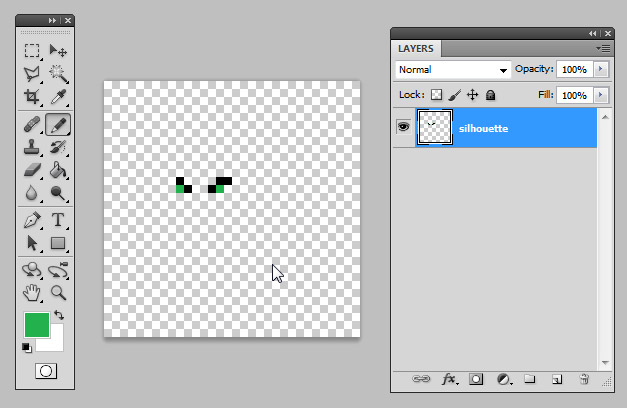
Yay! I'thousand pixelling!
Y'all could already start with the lineart (drawing as you usually would, making the lines and shaping the character), but a more applied way to practise so is to first make its silhouette. The adept affair is that yous don't need to be perfect on this phase, just try to take the sizes of things (head, torso, arms, legs) and the character's initial pose.
Become ahead and draw something similar this with a gray color:
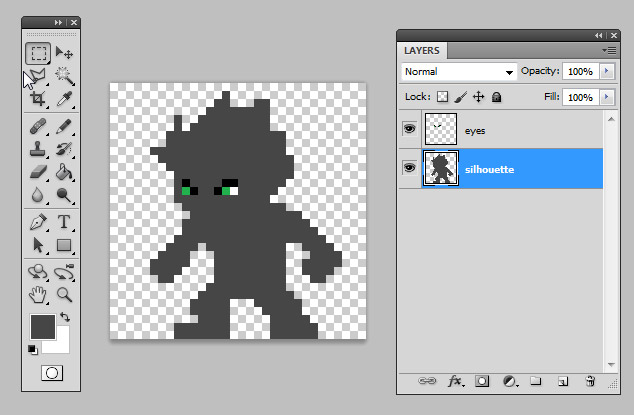
Doesn't need to be perfect at this stage
Notice that I also left some blank infinite. You don't actually need to fill the whole canvas, you'll need more than space for hereafter different frames, and it's very useful to keep the same sheet size for all of them.
Once you end the silhouette, information technology'south time to begin the lineart. At present you should be more careful with pixel placement, and then don't carp making the clothes, armors or any details yet. If y'all need it, you lot can add a new Layer so yous never lose your original silhouette.
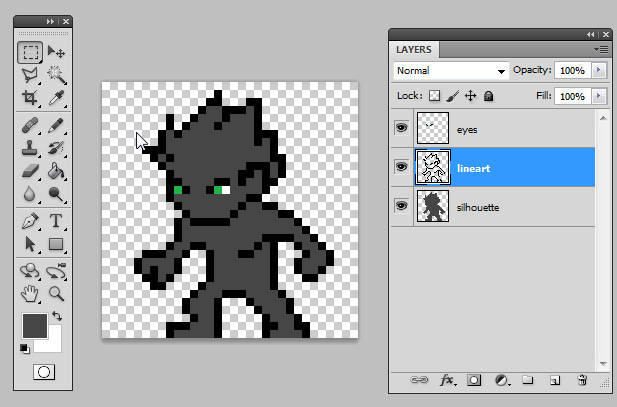
If you experience that the pencil tool is a bit too slow to depict, yous can always use the Line tool to makes things fast – only think to fix some pixels since it'due south not every bit exact as the Pencil. You'll need to configure information technology though, as shown below:
Choose the Line tool by pressing and holding the Rectangle tool, and gyre down to Line.

Go to the tool settings bar and select the third icon ("Fill pixels"), change the Weight to 1 (if information technology isn't already) and uncheck "Anti-alias" (your nemesis!). It should look like this:

Tip: Discover that I didn't made the bottom outline for the feet. It'due south not really necessarily since feet are not such an essential role to distinguish equally the legs are AND you lot save a row of pixels in your canvas.
Applying Colour and Shading
Now you're ready to start colouring it. Don't carp choosing the right colors at present, it's very like shooting fish in a barrel to change them later, just make sure that everything has its own colour. For now, y'all tin can apply the default colors from the Swatch tab (Window > Swatches).

Get alee and color your hero kinda like this (but feel complimentary to exist creative and use your own colors!)

Good colour contrast makes a better readibility of your asset!
Notice that I still didn't make whatever outline for clothes or hair. Always recollect: save equally many pixels as you tin!
Oh, and don't waste time by carefully placing each color pixel. To speed things upwards, describe the lines for each color and utilize the Paint bucket tool to fill up the spaces. Y'all'll need to configure this tool too. Select it on the tool bar (or just printing 'M') and modify the Tolerance to 0 and uncheck anti-alias.

Tip: If you ever need to utilise the Magic Wand tool (a very useful tool that select all pixels with the aforementioned color), use the same settings as the Pigment bucket – no tolerance or anti-alias.
The next step volition require yous some basic light and shading knowledge. If you don't know as well much about information technology, here'due south a quick guide for it, and a more complete one here. If you don't experience like learning this correct at present, you can skip this pace and go toward to "Spicing up your palette" – shading, afterwards all, is a matter of mode, choose what you feel right for your game and capability.
Or, you can simply make your shading similar to my example below!
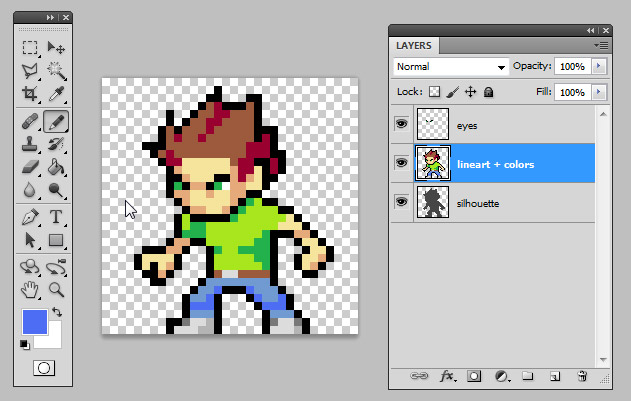
Use the same light source for the whole asset
Effort to give equally much shape every bit you want/can, this is usually where the nugget begins to look richer. For case, you can now run into a nose, eyes frowning, hair volume, depthness and folds on his pants. You can also add a few light spots to it, it will wait even better:
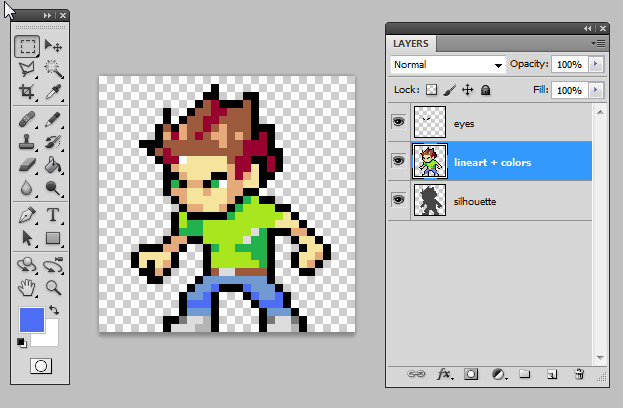
Go on the same light source from the shading
Spicing Upward Your Pallete
A lot of people utilize the default palette colors, but since so many people use those colors they wait the same beyond many games.
Photoshop has a not bad range of colors on its standard pallete, but don't rely too much on information technology. It's best to make your own colors by clicking the primary palette at the bottom of the tool bar.

And then, in the Colour Picker window, browse through the right-side bar to choose a color and in the main surface area to choose its effulgence (more white or more than black) and saturation (more vivid or duller).

Once you lot cull information technology, click OK and reconfigure the Paint Saucepan tool. Don't panic, you will just uncheck the "Contiguous" box, so when you lot paint the new color, every pixel with the same color in the layer will exist painted too.
This is another reason why it's important to keep the colour count depression, and to always utilize the same color when dealing with the aforementioned element (shirt, pilus, helmet, armor and then). But don't forget to utilise a unlike color for other areas, otherwise it'south going to be recolored too!

Uncheck the "Face-to-face" box to paint all pixels from the same color
Change the colors as much as you want and become some sexy colors on your character! You can fifty-fifty recolor the outline, merely make sure information technology will blend correctly with the groundwork.
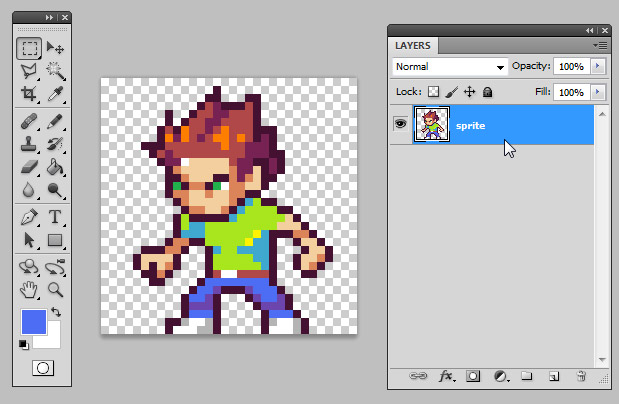
Finally, make a background colour test: make a new layer underneath your character, and fill it with various colors. It's actually of import to brand sure your graphic symbol will exist visible on low-cal, nighttime, warm and cool backgrounds.
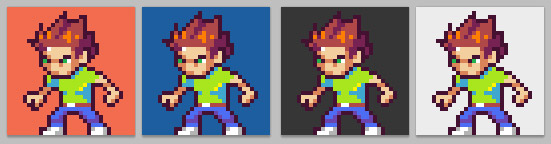
Tips on Editing Pixels in Photoshop
As you could see, I turned off the anti-alias on all of the tools I've used so far. Don't forget to plough it off on others tools likewise, such as the Elliptical marquee and Lasso tool.
It could come out handy to resize a little bit some parts or even rotate them to animate further frames similar running cycles. To do so, use any marquee tool (hit 'Chiliad') to select an area, right-click information technology and choose 'Free Transform', or simply hitting Ctrl+T. You'll be ble to resize and rotate it freely.

However, Photoshop automatically anti-alias everything edited using the Free Transform function. Before confirming your edit, go to Edit > Preferences > Full general (Ctrl+Grand), and alter the "Image Interpolation" to "Nearest Neighbour". In a nutshell, information technology calculates the new position and size very roughly, applying no new colors or transparency, preserving the colors yous chose.

Integrating Pixel Art into an iPhone Game
Hi everyone, it'south Ray here, and I'm jumping into this tutorial at this signal to show you how you can integrate the pixel art you just made into an iPhone game using the Cocos2D game framework.
If you are new to Cocos2D or iPhone development in full general, you might want to kickoff with one of the many other Cocos2D and iPhone tutorials on this site starting time. Once yous have Xcode and Cocos2D installed and understand the basics, read on! :]
Create a new project with the iOS\cocos2d v2.x\cocos2d iOS template, name it PixelArt, and select iPhone for the device family.
Drag the concluding pixel art character you created into your project.
Then open HelloWorldLayer.m and supercede the init method with the following:
-(id) init { if( (self=[super init])) { CCSprite * hero = [CCSprite spriteWithFile:@"sprite_final.png"]; hero.position = ccp(96, 96); hero.flipX = YES; [self addChild:hero]; } return self; } We position the sprite to the left side of the screen and flip him so he'southward looking to the correct.
Compile and run, and you'll come across your sprite as expected on the screen:

However, remember as we discussed earlier in this tutorial, we wanted to scale up the art artificially big so the individual pixels are really visible to requite an extra-blocky cool pixel art feel.
So add this extra line inside the init method:
hero.scale = 2.0; Easy, right? Compile and run and… wait a infinitesimal, our sprite is blurry!

This is because by default Cocos2D anti-aliases art when information technology scales it. For pixel fine art nosotros don't want that – we desire to preserve the hard edges.
Luckily, this is quite piece of cake to prepare! Just add this actress line:
[hero.texture setAliasTexParameters]; This configures Cocos2D to scale the image without anti-aliasing, and then it still looks "pixel-similar." Compile and run and w00t – it works!
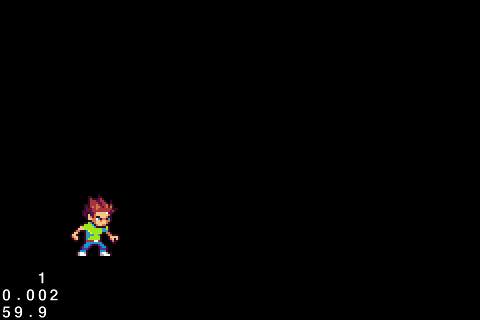
Detect the advantage of using pixel fine art – we were able to use a smaller image size than what is actually displayed to the screen, saving a lot of texture retentiveness. And we don't fifty-fifty need to provide separate images for the retina display, as nosotros want that blocky look!
That'south information technology for me – dorsum to Glauber, who will wrap it up!
Where To Go From Here?
I hope you all enjoyed this tutorial and learned a bit more about pixel fine art!
Before we go, hither are some concluding tips:

- Ever call back to avoid using anti-alias, gradients or also many colors for your assets. This is for your ain adept, unless you lot really know what you lot're doing.
- If you Actually want to emulate a retro style, look for art from quondam consoles with limitations, such as 8-chip or 16-bit consoles.
- There are Enough of styles in pixel art bated from the 'retro' ones. As hardware advanced, assets could use more or just different (sexier!) colors. This led to more variation and even new artists who didn't know how to use older hardware making pixel fine art. Newer consoles similar Game Boy Advance, Nintendo DS, Playstation 1 and some mobile phones have games with these styles, so look into those!
- Some styles don't apply dark outlines; others don't even utilize light or shadow variation. It depends on the style! Knowing how to shade the art is expert, which is why nosotros went through information technology in this tutorial, but keep in heed the manner you are going for.
- If y'all experience confident, you lot tin search more detailed tutorials for these terms: isometric, dithering, anti-allonym (aye, there is a way to make information technology without automatic tools), celout and subpixel animation.
Pixel Art seems easy to nail as it is piece of cake to get started, but it's actually very enervating and takes some time to get the hang of it and make good pixel art.
The all-time manner to advance your skills is to exercise, practice, practice – and become some feedback from fellow pixel artists!
I highly recommend posting your work in pixel art forums to accept other artists requite you lot advice – a great mode to meliorate your technique! Commencement pocket-size, practice a lot and go feedback, and you can create crawly game-gear up pixel art!
If you have any questions near pixel art, please join the forum discussion beneath – and I hope to come across some peachy pixel art from y'all guys in the future! :]
This is a guest post past Glauber Kotaki, an experienced 2nd game artist available for rent.

Source: https://www.raywenderlich.com/2888-introduction-to-pixel-art-for-games
Posted by: rodriguezfitte1962.blogspot.com
0 Response to "How To Draw A Pixel Character Traditionally"
Post a Comment