

How To Draw Hair Digitally For Beginners
Hair is very important for our characters, lending a personality of its ain, then drawing hair exactly as we imagine it can be a existent challenge.
But in that location are many different approaches we tin accept! For me, the near important dominion is to empathise what I am drawing, so that I don't get lost halfway through.
1. Structure and volume
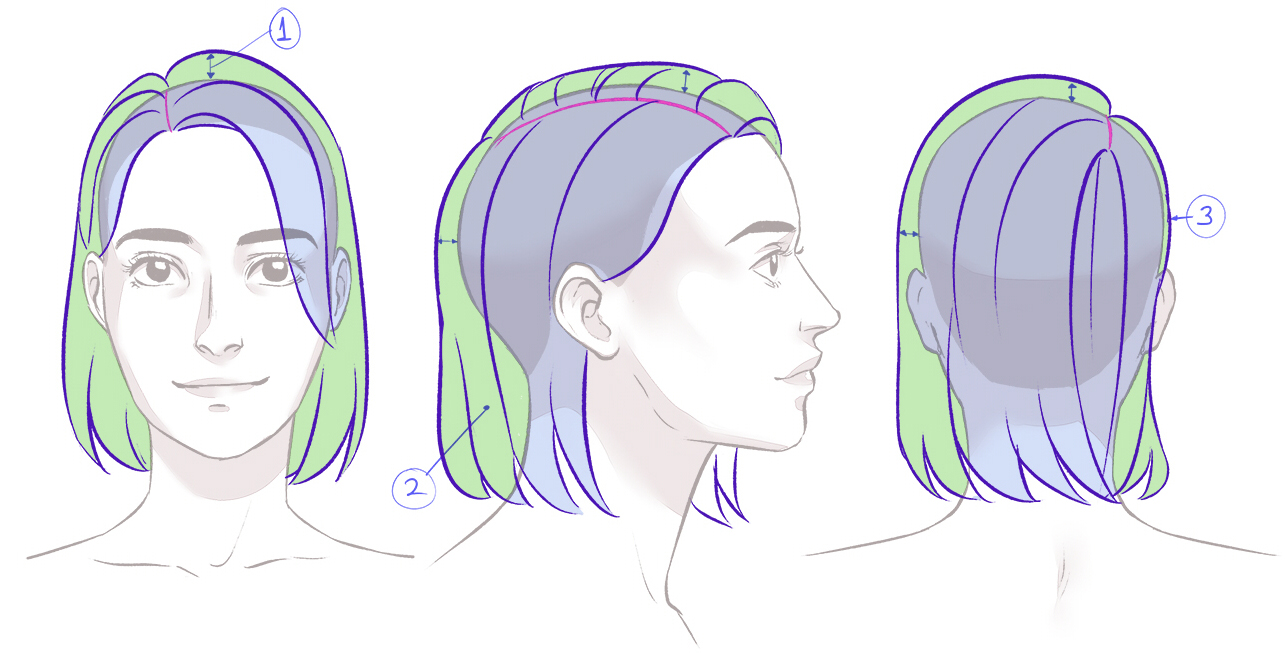
First, we must ascertain the areas of our grapheme's hair. Marking a reference betoken or a route which divides the hair can help us. For instance, at the hair departing (1). From in that location, it becomes easier to see the direction that each department will take (2).
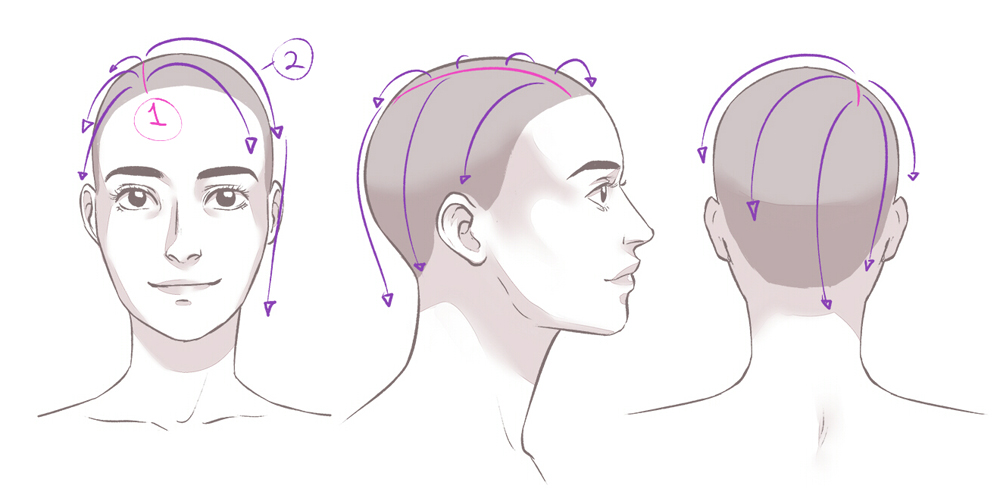
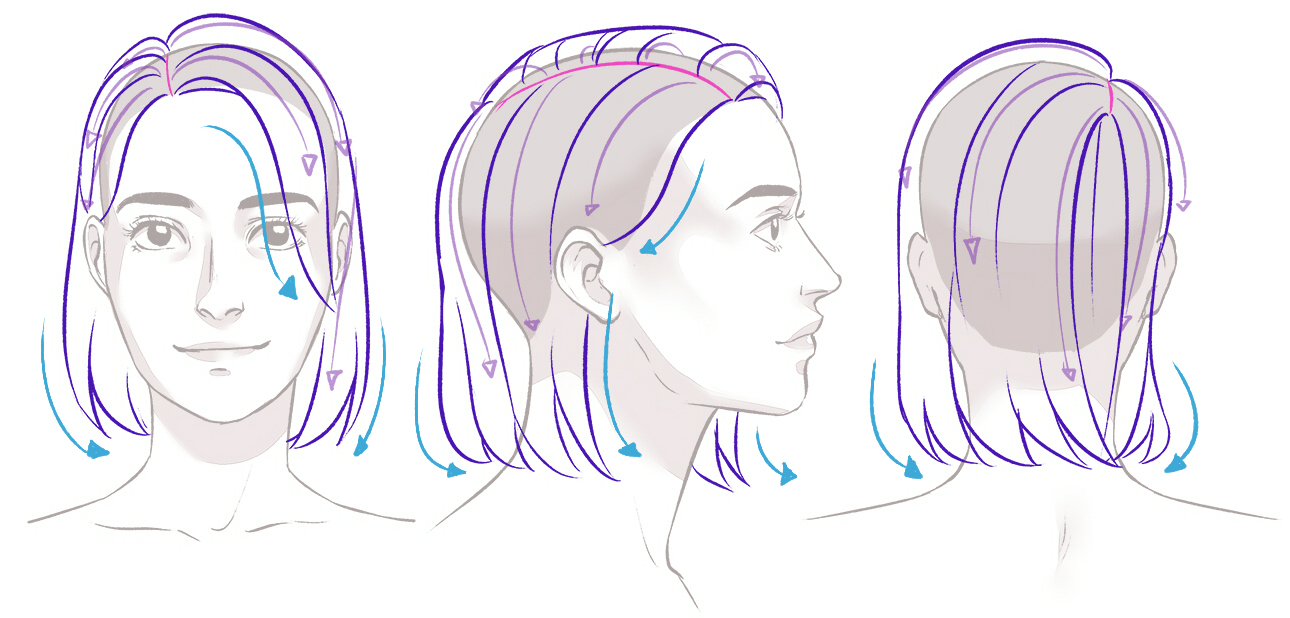
As my drawing advances, I ponder some possibilities. This grapheme will have straight hair, cutting just over the shoulders. I call back no bangs would be improve, but I want some hair to embrace one heart, and the tips of the pilus to curl inwards.
I beginning to draw these lines. I might change my mind afterward on, just this stage allows me to see more conspicuously.
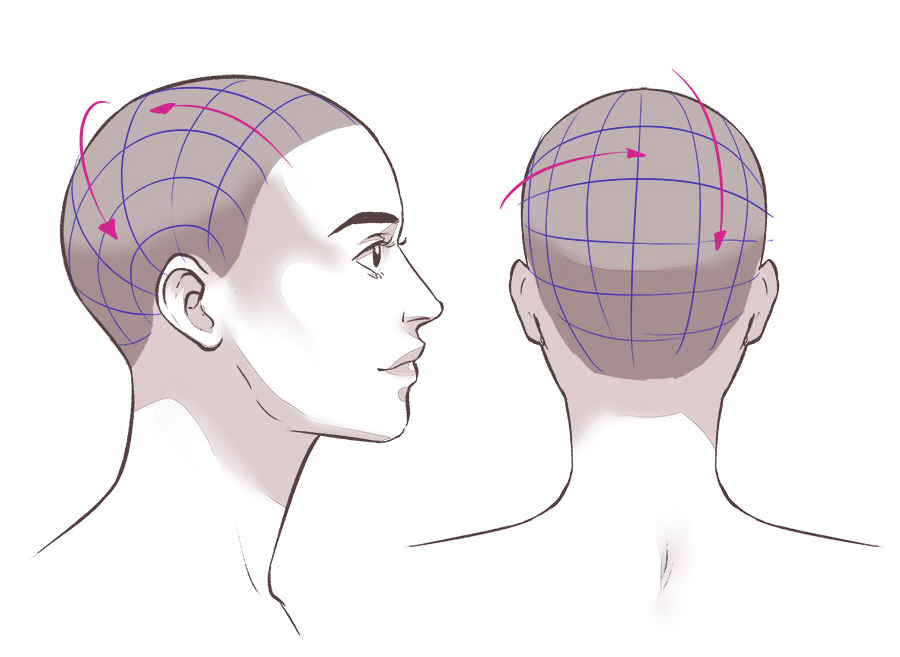
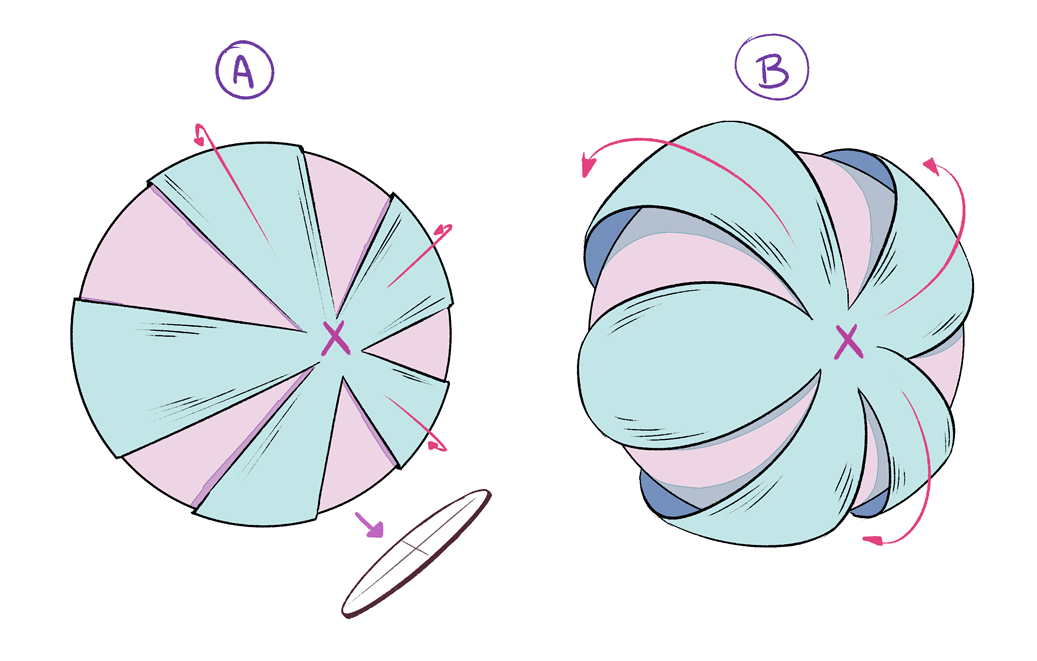
The head is a sphere. If nosotros don't take that into business relationship, the cartoon could kickoff to flatten. This is a fairly mutual error. Let's have a await using a mesh to demonstrate:
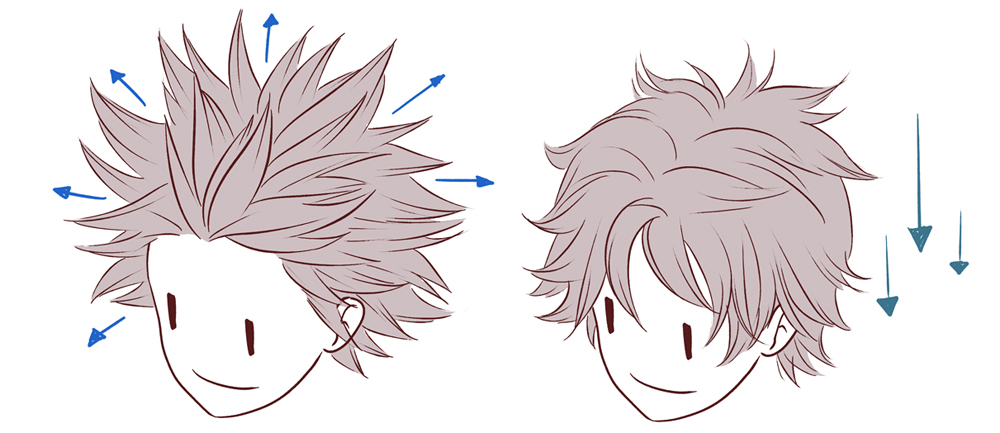
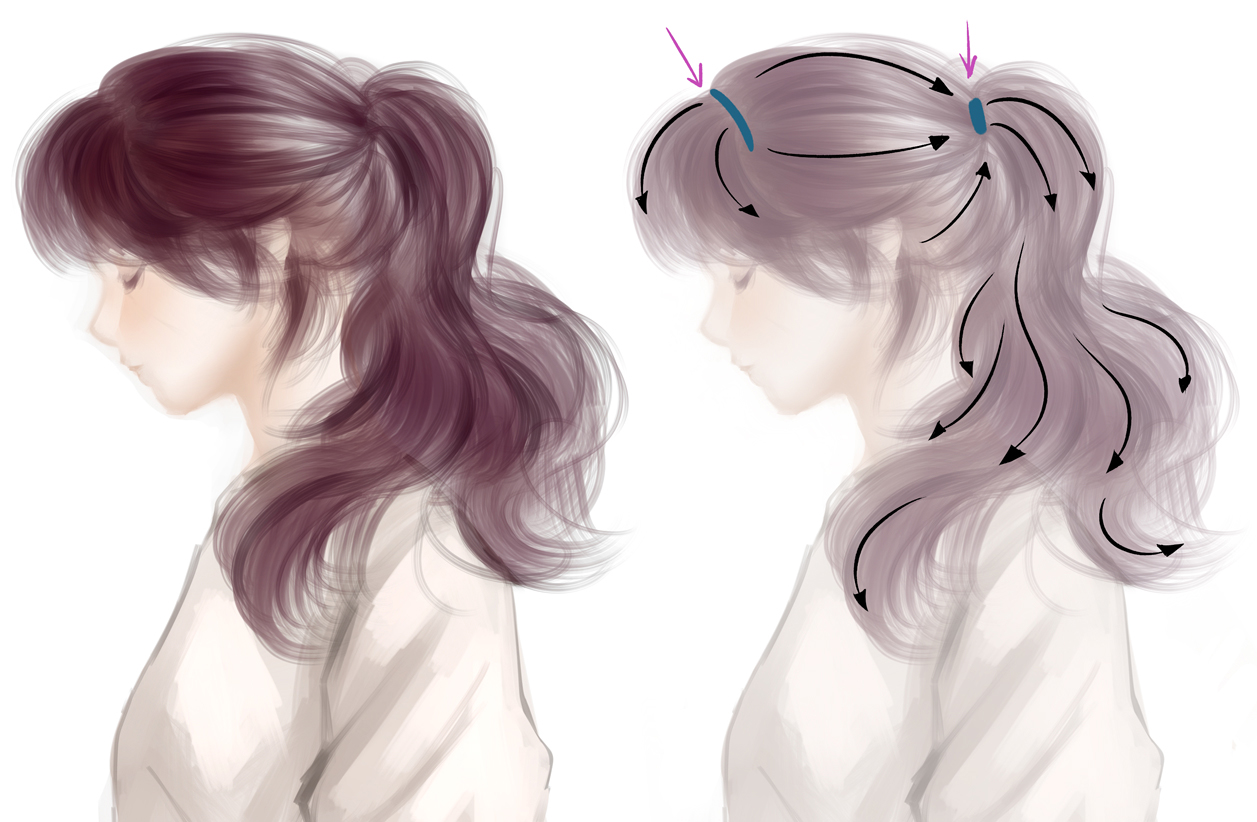
Each hair comes from a specific point and grows in a dissimilar direction. Even when the hair is very long, the gravitational force somewhen brings information technology down.
Hair locks must somehow wrap the head following the curves of its surface. Check the difference between these two images. Both circles have a layer around them, but A looks more like a flat shape, whereas B looks to be more than spherical.
Hair does not gum itself to the head. Allow's keep in mind that in that location is always space between strands and over layers of hair, which builds upward to create volume.
• The greenish area (1) indicates the gap betwixt the head and the border of the pilus.
• On the back of the head (ii) in that location are several layers of hair, but since it'south straight hair, the edges are almost unaffected, which allows a very subtle falling effectually the neck.
• The volume varies depending on the amount of hair on each side of the head (three).
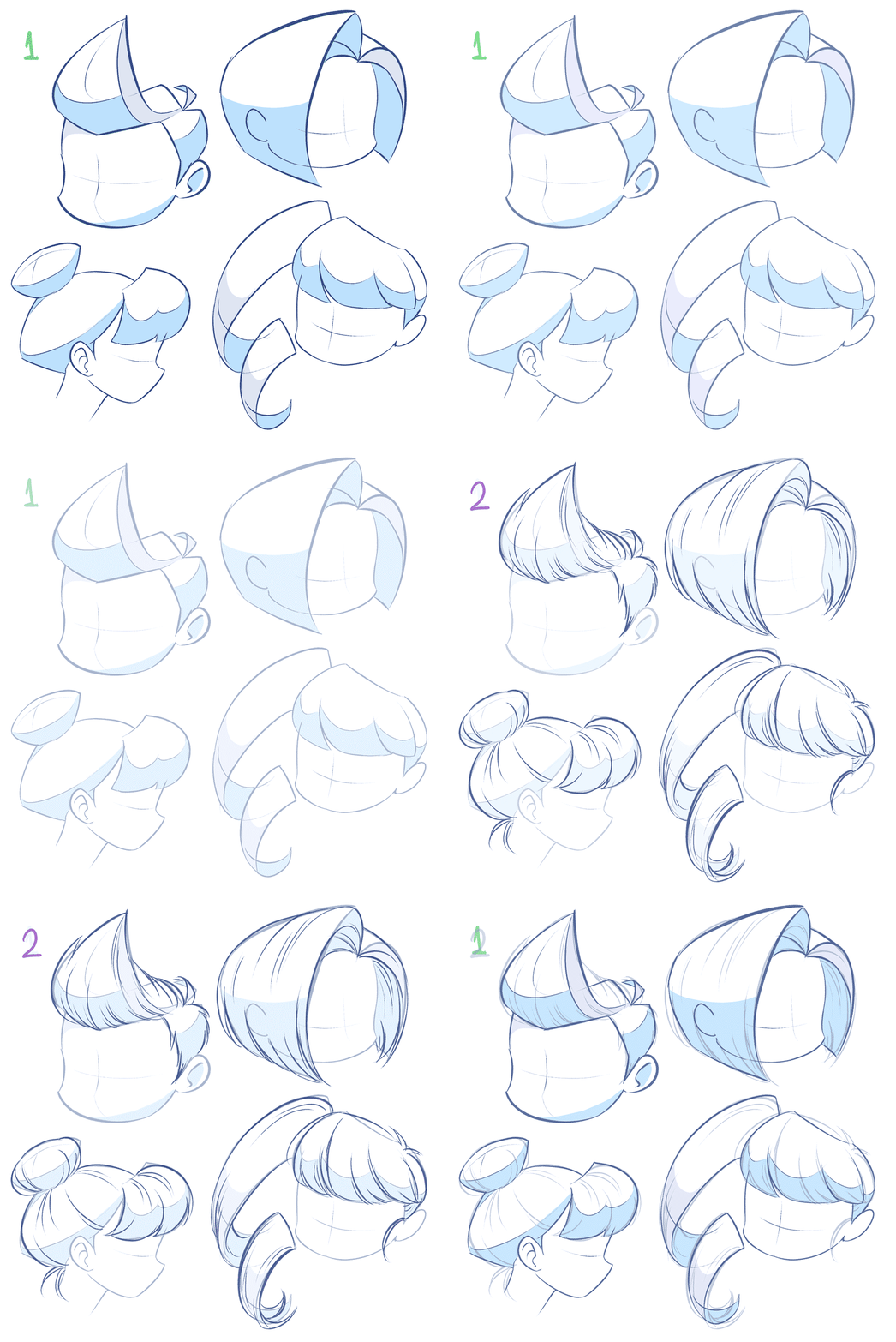
Many artists choose to simplify the pilus using basic shapes, or anything else that helps them define the volume, the angles, and to easily approach values. Then they add details to the surface.
Chore: I always recommend learning using real-earth references. Take some photos of hair styles and place where the locks are coming from and where they are going. You tin can too draw their edges.
▲Blithe GIF
2. Shape:
Some drawing styles demand more than effort in the detailing phase than others, simply it is always necessary to take into account the standard characteristics of hair. Permit's look at it this way:
The overall hair is a prepare of many locks > locks are a set of strands
• Pilus does not form a compacted shape, nor a consistent ane. It is very calorie-free, then when the character moves, the wind, the humidity, or annihilation that surrounds information technology can bear upon its silhouette.
Permit'southward see some examples, footstep by step:
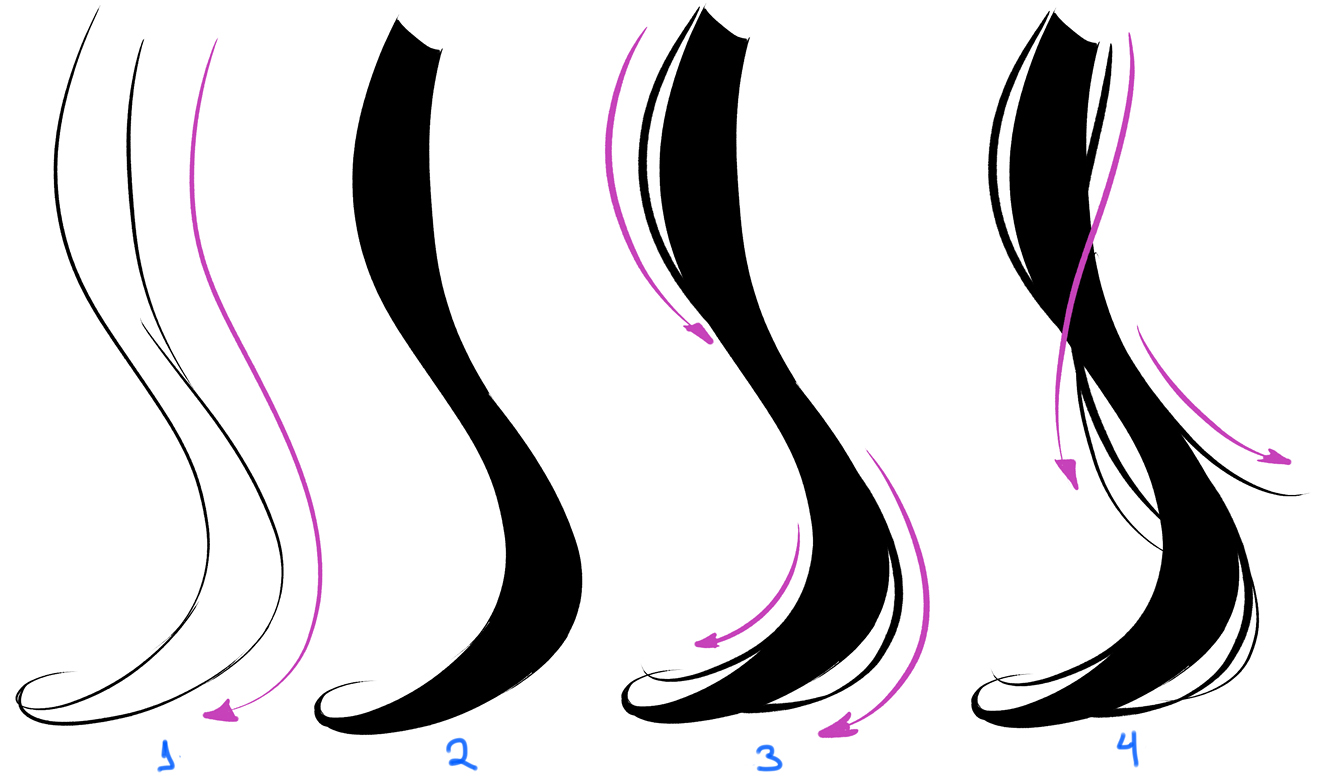
Straight hair:
• My commencement pace was to draw the edges of the primary lock (the ane which will be the base of our drawing), post-obit the management in a Southward shape. Then I filled it in to create its silhouette.
• The trivial strands on Step 3 follow a very similar direction, but slightly more than pronounced, enough to add dynamism to the shape.
Finally, I added some strands which movement in completely different directions than the original one, to balance the limerick and make information technology more attractive.
Curly hair:
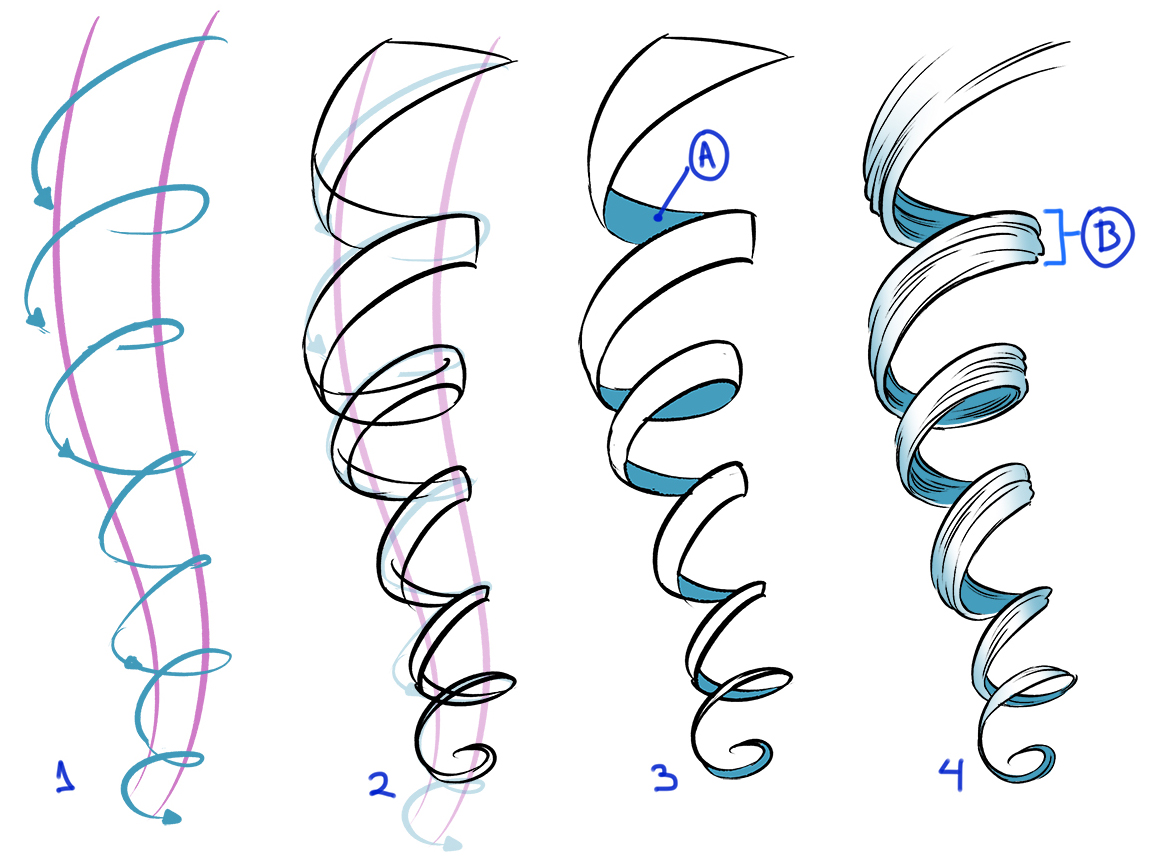
• The lock curls itself around in a cylindrical shape. Try not to make this shape completely straight, otherwise the lock will end up looking similar a bound!
• So I simplify, offset drawing a ribbon. Run into how information technology becomes thinner every bit it approaches the tip. The third footstep is to item the external and internal sides (A).
• I added some texture, following the direction of the curves. I also put in some irregularities around the edges to lucifer the surface (B).
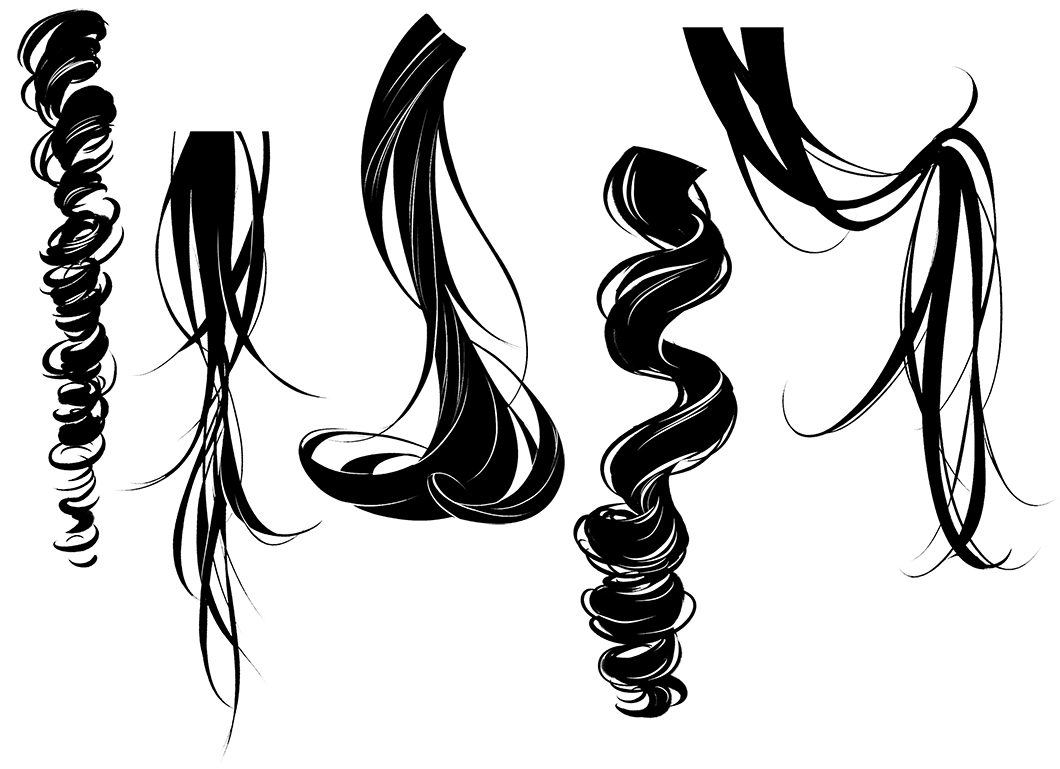
We can use this method to create more than interesting and circuitous silhouettes:
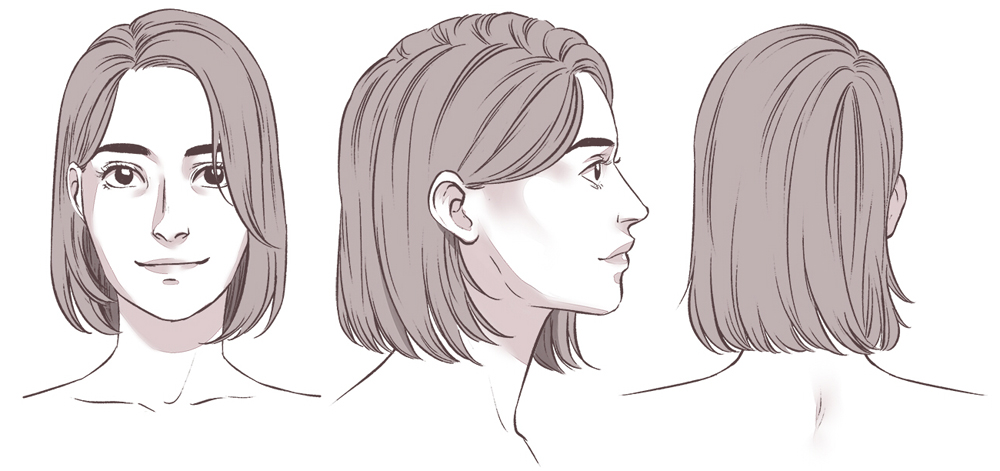
I followed all these criteria to brush up my grapheme and then I added the necessary amount of detail while keeping it simple.
3. Adding values:
I am going to use the value scale to ascertain details and give a 3D event to the shapes.
The beneath image is a hairstyle consisting of irregular layers and overlapping locks. If nosotros merely had the silhouette, we wouldn't notice all these details, thus I need to contrast the unlike sections in gild to highlight these shapes.
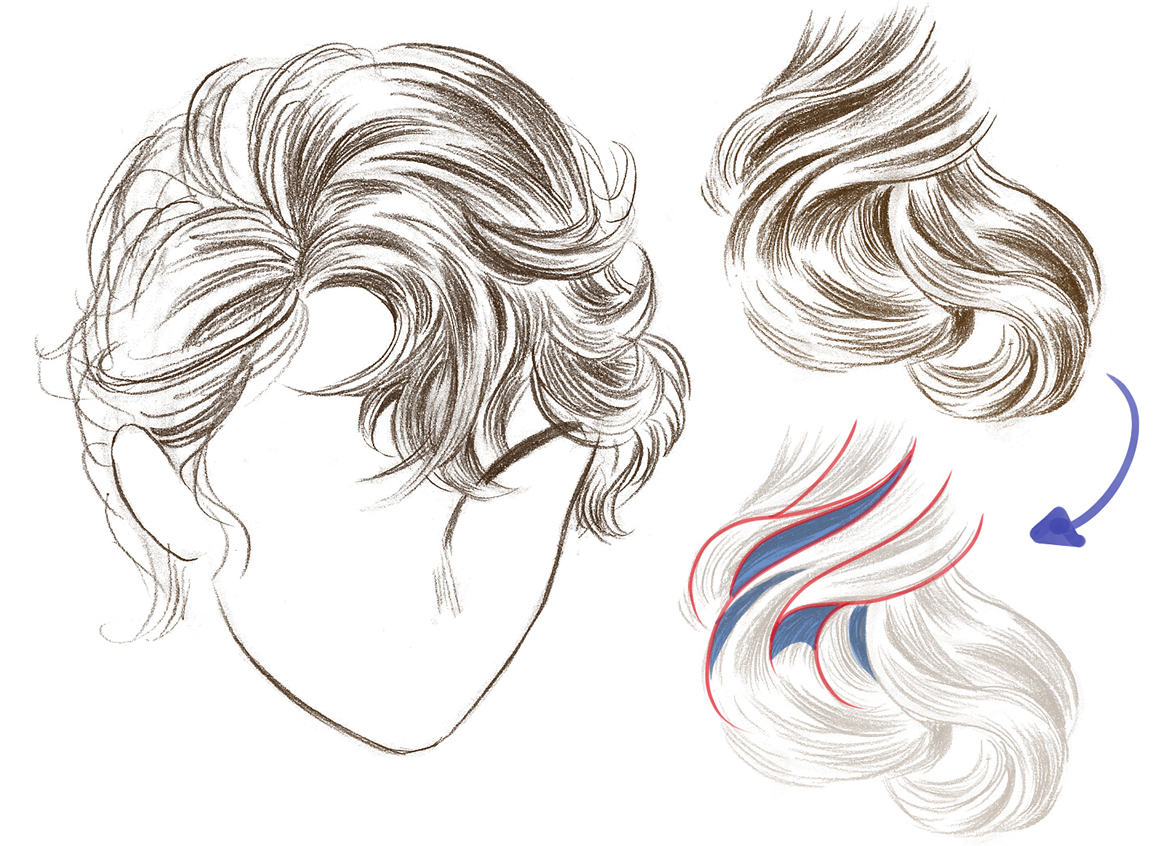
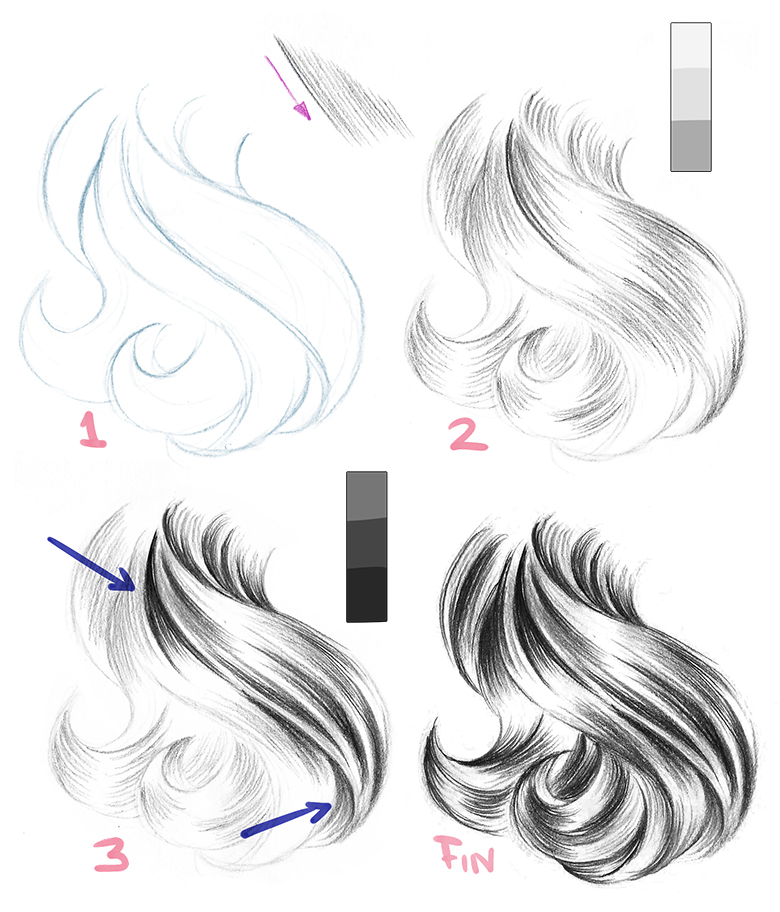
This is the footstep-by-stride process which volition help us empathize better:
• I define the edges (one). In stride 2, the mid-tones can be seen in the corner; the strokes follow a single direction to maintain the harmony of the shape, and the illuminated areas are left bare.
• In step 3, we apply darker shades to darken and deepen some areas, for example, on the overlapping layers equally indicated past the arrows. I continue this way until the drawing is finished.
Information technology is not a problem if we are merely guided by our intuition when cartoon shadows and lights. "Lighting" is an extensive and super interesting topic, and I am agape that what I explicate here is not enough to embrace it! I'd recommend researching and practicing as much every bit possible.
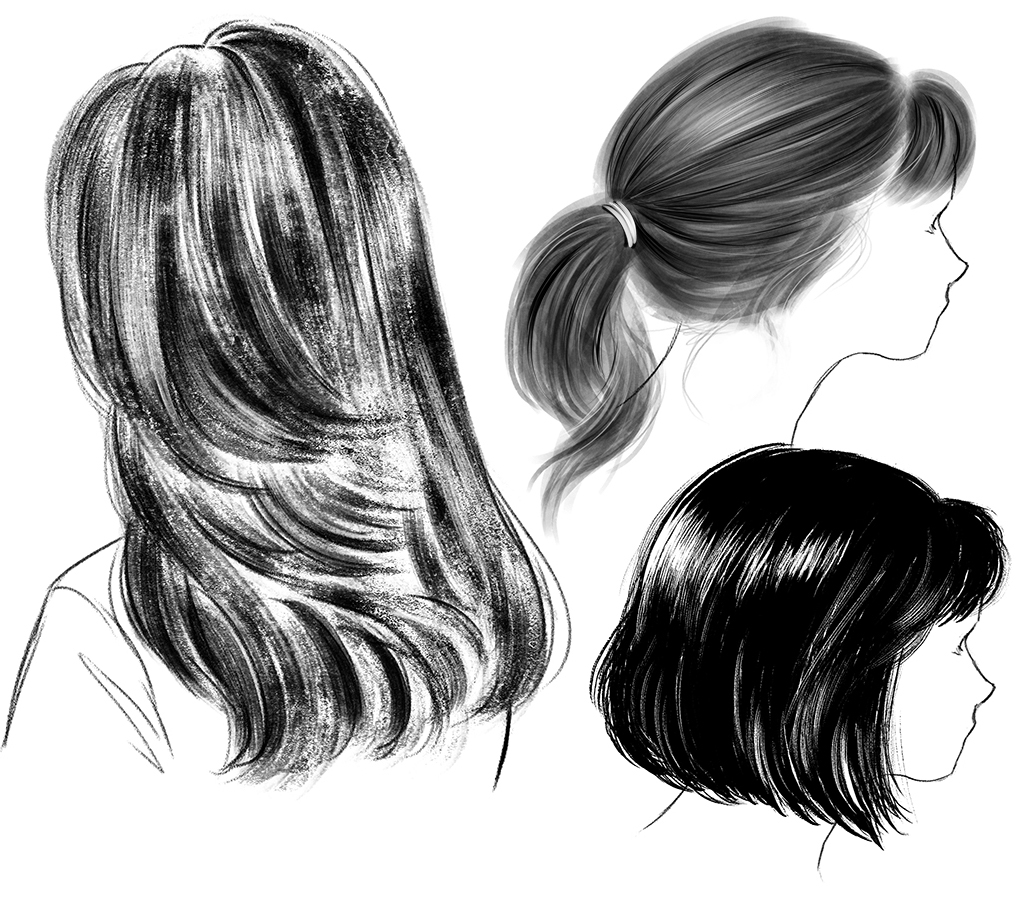
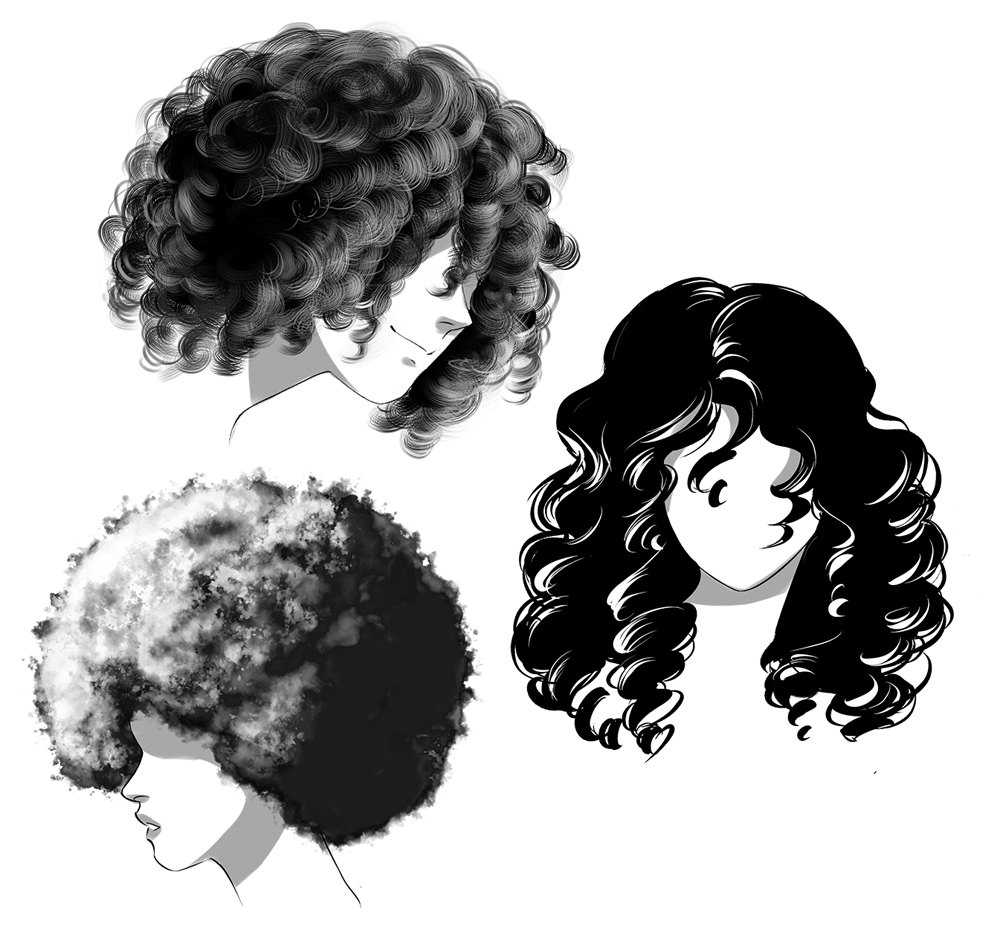
Pilus types and textures:
Textures make unique sensations and enrich our illustrations. It may exist overwhelming to remember virtually hair textures, just instead of working exclusively with lines, we must non reject other tools that tin can make tasks easier as well equally creating incredible furnishings, both in digital and traditional art spaces. It is always proficient to experiment to develop methods that highlight the qualities of our style!
I don't accept a unique answer to which tool to use in each instance, but here is a clue: imagine the feeling of each type of hair!
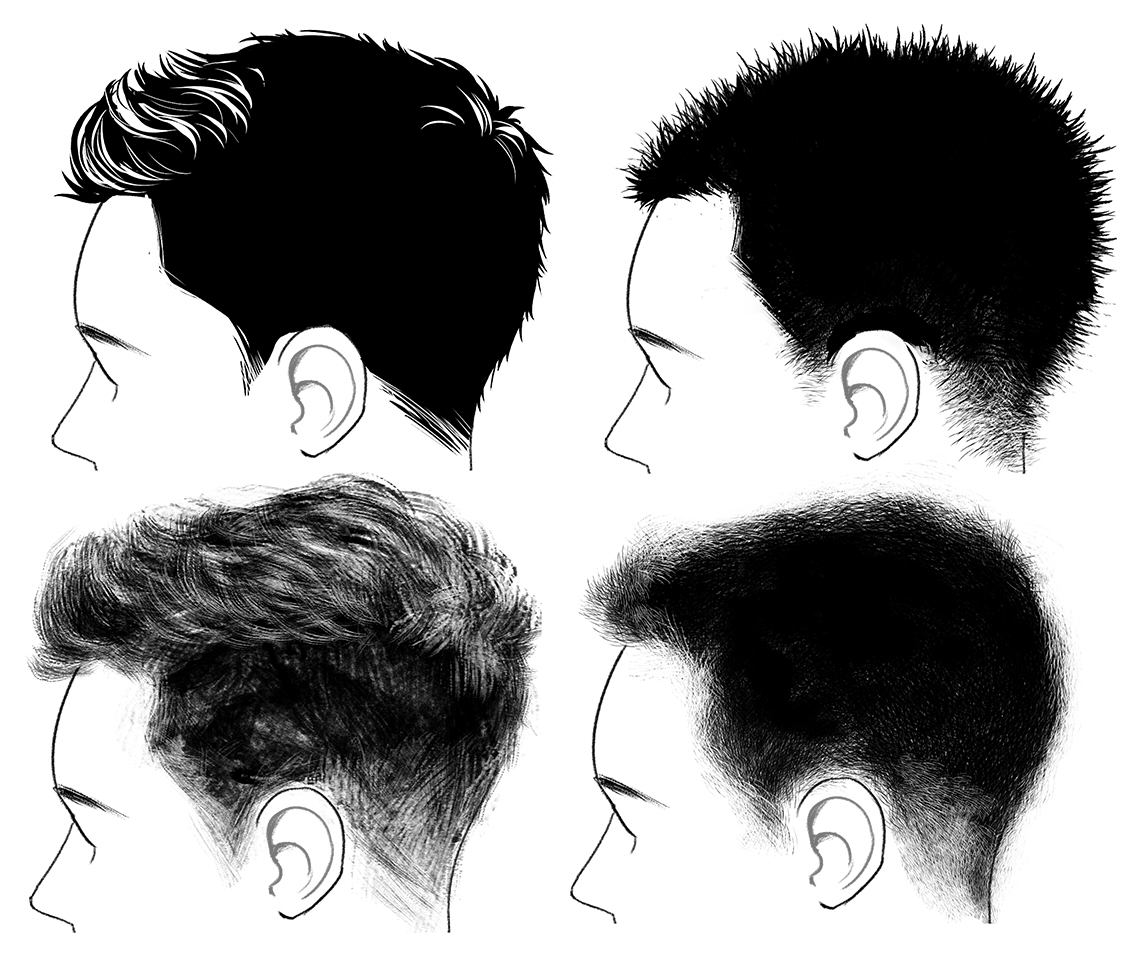
Brusque, virtually shaved hair feels like a rug —I've always idea then! And when I draw information technology, I similar to give it a prickly, pointy, rough appearance.
For wavy hair, I recollect about the body of water waves, curves finding ane another. At that place is life, energy, and movement.
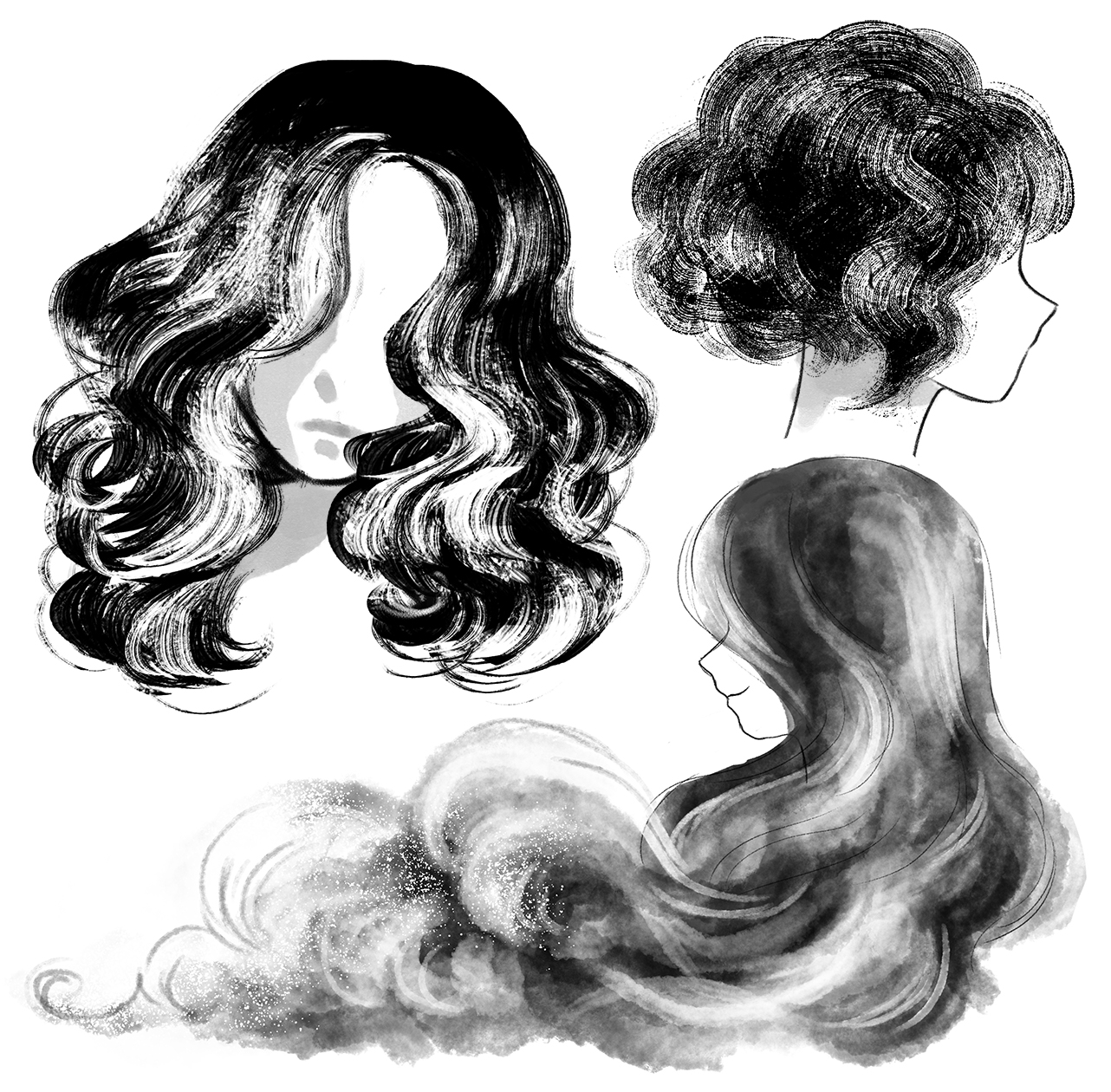
On the other hand, straight hair has serene, calm, simple and maybe elegant lines.
Explosive —just non also much, curly hair is voluminous, hard to control and, many times, difficult to comb! Fluffy, soft, playful and gorgeous, those are some adjectives we can think about. Textures save time and add complexity to the shapes.
Conclusion:
These are all general approaches that utilise can utilize to make hair expect like hair. If you lot want to go further, intermission the rules! There is nothing wrong in, for case, ignoring gravity, or exaggerating the volume of hairstyles, or creating hair made of fire! There are and then many possibilities we can play with to create new things. I hope this commodity has been helpful for you. If you wish to see some of my works, please accept a wait at my social networks and my portfolio:
https://www.instagram.com/eri_duh/
https://twitter.com/eri_duh
https://www.artstation.com/eridey
Thank you very much for reading!

Source: https://www.clipstudio.net/how-to-draw/archives/159719
Posted by: rodriguezfitte1962.blogspot.com
0 Response to "How To Draw Hair Digitally For Beginners"
Post a Comment